


China vacuum formed car parts manufacturer


Shaping the Future: How Vacuum Forming is Revolutionizing Car Parts
In the high-stakes world of automotive manufacturing, where cost, weight, and design freedom are paramount, one surprisingly accessible technology is making a significant impact: vacuum forming. Moving far beyond its roots in packaging and simple consumer goods, this process has become a vital tool for creating everything from rugged interior dashboards to sleek aerodynamic body kits, proving that simplicity can be a powerful asset.
The Core Process: Simplicity in Action
Vacuum forming, at its heart, is an elegantly straightforward process:
Sheet Clamping: A flat sheet of thermoplastic material (like ABS, acrylic, or polycarbonate) is securely clamped into a frame.
Heating: The sheet is heated until it becomes soft, pliable, and rubbery.
Forming: The softened sheet is draped over a precision mold. A powerful vacuum pump then instantly sucks all the air out from between the sheet and the mold. The immense force of atmospheric pressure pushes the plastic down into every contour of the mold, perfectly capturing its shape.
Cooling and Trimming: The plastic is allowed to cool and harden before being removed from the mold. The final part is then trimmed from the surrounding material.
This simplicity is its greatest strength, especially when compared to more complex processes like injection molding.
Why the Auto Industry Embraces Vacuum Forming
The benefits of vacuum forming align perfectly with the demands of modern vehicle production:
Remarkable Cost-Effectiveness: The molds for vacuum forming are significantly cheaper and faster to produce than the hardened steel tools required for injection molding. This makes it ideal for low-to-medium volume production, custom parts, and rapid prototyping.
Unmatched Design Freedom for Large Parts: It excels at creating large, single-piece components with complex curves. Think of a truck's massive door liner, a full-length dashboard, or a rugged underbody shield-these are ideal candidates for vacuum forming.
Lightweighting: As the automotive industry relentlessly pursues weight reduction for better fuel efficiency and electric vehicle range, vacuum-formed parts offer a compelling solution. They can produce thin-walled, strong, and lightweight components that directly contribute to this goal.
Speed to Market: The rapid tooling process allows designers and engineers to iterate prototypes and bring new models to market much faster.
Common Vacuum-Formed Car Parts
You might be surprised by how many parts in a vehicle are created this way:
Interior Components: Dashboards, door panels, trunk liners, and headliner substrates.
Exterior Bodywork: Lower door panels, wheel arch liners, bumper skins, rocker panels, and even large components like gull-wing doors or hoods for specialty vehicles.
Under-the-Hood: Battery covers for electric vehicles, air intake boxes, and protective covers.
Concept & Custom Vehicles: The go-to method for creating one-off body panels and interior elements for concept cars and the custom tuning scene.
Pushing the Boundaries: Advanced Techniques
To overcome its limitations-such as uniform wall thickness and less fine detail than injection molding-the process has evolved:
Pressure Forming: Adds positive air pressure on top of the sheet, forcing it into the mold with greater detail and sharper corners, achieving a look very close to injection molding.
Multi-Station Formers: Allow for high-volume production by heating, forming, and cooling multiple parts simultaneously.
In-Mold Lamination: A fabric, vinyl, or even a thin wood veneer is placed in the mold before the plastic sheet. During forming, the material is permanently bonded to the part, creating a finished surface in a single step.
The Future is Formed
Vacuum forming is perfectly positioned for the future of the automotive industry. As electric vehicles demand new types of components and the desire for customization grows, the agility and cost-effectiveness of this process will only become more valuable. It stands as a testament to the power of a simple idea, proving that sometimes, the best way to shape the future is by sucking all the air out of the room.
Our capability
| Item | Capability |
| Common used material | ABS/PP/PC/PVC/PET/PMMA/ABS+PC, ABS+ASA, ABS FRV0, ABS-ANTI UV, ABS+TPU |
| Max thermoforming size | 2.8m |
| Thickness | 0.3-12mm |
| Product accuracy | 0.05-0.1 |
| Mold type | Aluminum mold |
| Surface treatment | Spraying, electroplating, silk screen printing, laser engraving |
| Daily output | 3000pcs |
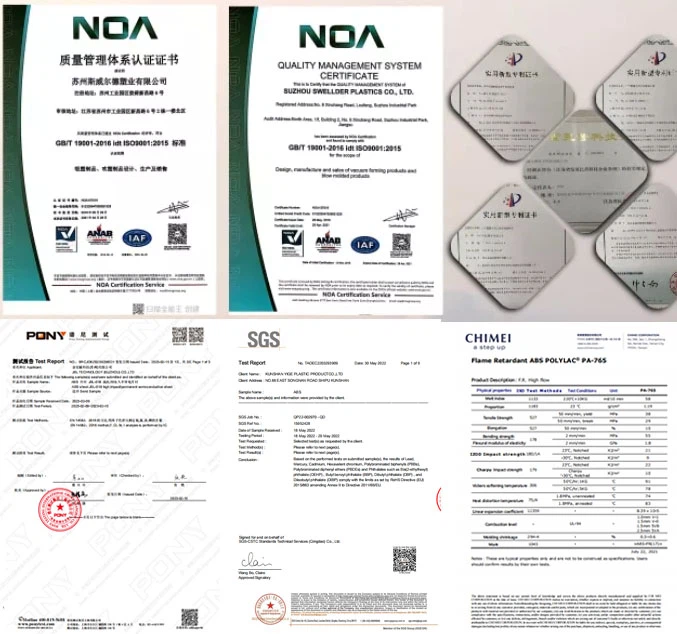
"ISO9001 internationally certified factory | 20 years of experience in precision vacuum forming manufacturing | Strict quality control process ensures that each product meets international standards"
√ ISO9001 certified enterprise
√ Export-level quality control
√ Precision thermoforming process with error <0.1mm
√Support customized production solutions
√The thermoforming supplier chosen by 300+ customers worldwide
√Passed ISO9001:2015 quality system certification
√ Product defect rate <0.3%
√ 7-days fast proofing service
FAQ
Q:What is the minimum order quantity for vacuum-formed parts?
A: Prototypes (<50), small batches (50-5,000), and large-scale production (5,000+).
We offer quotes for small-batch vacuum forming.
Q: What materials are available for vacuum forming?
A: ABS, PS, PET, PVC, PC, ABS+PC, ABS+PMMA, ABS+ASA, and other composite materials.
Q: What is the maximum part size?
A: A: Up to 2.8mm, supporting large vacuum forming processes.
Q: What surface treatments are supported?
A: Spraying, silk screen printing, electroplating, fusing.
Submit your requirements♂
our engineering team will provide you with a free quote and design for manufacturing (DFM) analysis within 24 hours.♀
Hot Tags: vacuum formed car parts, China vacuum formed car parts manufacturers, suppliers, factory, vacuum forming for car wiper blades, steering wheel horn buttons by vacuum forming, vacuum formed car floor mats, vacuum forming for car headlight lenses, Wheel Cover forming, car roof panel insulation by vacuum forming


