



Our factory

Our company was established in 2006. It is a comprehensive enterprise specializing in the thermoforming plastics industry, integrating R&D, design, production, and import and export trade. The company's products use various modified materials such as ABS, PP, PC, PVC, HIPS, etc.
The products are widely used in automobiles, home appliances, food, medical, toys, bathroom, advertising display , scientific research and teaching industries. The company has import and export business qualifications, relying on a mature and complete technical service system and customer-oriented corporate service tenet, and has established many business cooperation relationships in Europe, America, Southeast Asia, the Middle East and other regions.
Our more than 10 year relationships with our major customers are proof of our high quality standards and complete customer satisfaction. We have proven to be an innovator of new ideas for old products. We have the ability to form thin and heavy gauge materials, eliminating the necessity of dealing with multiple vendors. Let us be your Single Source Supplier of choice.we have cooperated with manyworld-renowned companies at home and abroad.Our credit and service has won good satisfaction from most of customers through long term and friendly cooperation.
Material suggestion
|
Characteristic Material |
Strength |
Clear |
Price |
Application |
|
ABS |
Good-High impact |
Not Avaliable |
Medium |
Caravan parts,vehicular parts, Electrical / Equipment Enclosures |
|
Acrylic/Pmma |
Medium to high strength |
Yes |
Medium |
Signs, light cover,domes, light diffusers |
|
PS |
Medium to good strength |
Yes(clarity not to quality of PETG/PC/PMMA) |
Medium |
Packaging, microgreens tray |
|
PC |
Very good impact strength |
Yes |
Expensive |
Machine guard, Cover, enclosure, light cover |
|
PP |
Soft |
Translucent |
Inexpensive |
Packing tray,containers,tank,enclosure, medical application |
|
HDPE |
Soft |
Translucent |
Inexpensive |
Enclosure, Vehicular parts |
|
PVC |
Good |
Yes |
Inexpensive |
Packaging, machine guard, car trim |
|
PETG |
Good-High Impact |
Yes |
Expensive |
Medical application |
Other products

Product packaging

Process

We have a rich-experience design group to help you customize tray with your products size, you just need to send us drawings
After confirm the order, samples need 7-14 days to produce for your check,2 samples are free


After confirmation of samples, finish time depend on the order quantity.
If you have forwarder, please send the contact information, and then we will contact to ship the products, if you do not have, please don't worry, we will find for you


If you have any problems, after receiving mass products, please contact the sales anytime, we will solve for you.
Contact information

FAQ
Our factory is located in Suzhou Industrial Park,adjacent to Shanghai, with a production workshop of 3,000 square meters. We are equipped with our own R&D, design, and sales teams, with experienced mold engineers, designers, production personnel, inspection personnel and export logistics and can provide customers with Provide rapid prototyping services and free samples. It has been very mature in using ABS, PP, PC, PE, PVC, PET, PETG, HIPS, PMMA and other materials and can produce high-quality products.

Why Choose Us
01
Our Service
Vacuum forming works with a variety of plastic materials, such as ABS, PVC, and PETG, providing flexibility in material selection based on specific needs.
02
Our factory
Our factory is located in Suzhou Industrial Park,adjacent to Shanghai, with a production workshop of 3,000 square meters.
03
Production Equipment
8 sets vacuum forming machines, 3 sets 5-axis cnc cutting machines, 2 sets 3-axis cnc cutting machines, 2 sets die cutting machines, 1set bending machine.
04
Production Market
Domestic, USA, Canada, France, Ireland, Belgium, Switzerland, Sweden, Finland, Australia, New Zealand, Japan, Korea and etc.

Vacuum Formed Plastic Packaging
Our credit and service has won good satisfaction from most of customers through long term and friendly cooperation.

Thermoformed Plastic Shipping Trays
Our company was established in 2006. It is a comprehensive enterprise specializing in the thermoforming plastics industry, integrating R&D, design, production, and import and export trade. The company's products use various modified materials such as ABS, PP, PC, PVC, HIPS, etc.

The products are widely used in automobiles, home appliances, food, medical, toys, bathroom, advertising display , scientific research and teaching industries.

The company has import and export business qualifications, relying on a mature and complete technical service system and customer-oriented corporate service tenet, and has established many business cooperation relationships in Europe, America, Southeast Asia, the Middle East and other regions.

PS Packing Tray PET Packing Tray
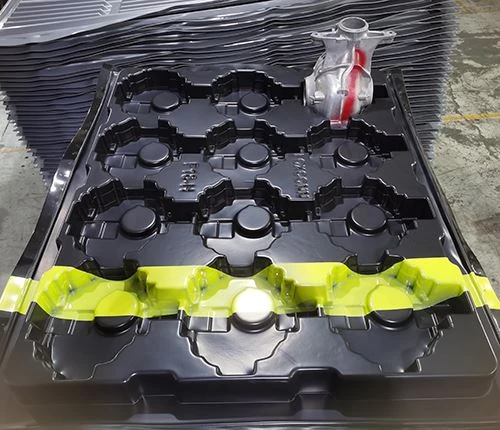
Engine related packaging pallets.Including gear tray, cylinder tray, pressure plate whole pallet packaging, engine tray, connecting rod tray, intake manifold tray.

Plastic Thermoforming Table Top
Plastic thermoforming table top production is a process that heats the plastic sheet and absorbs it onto the surface of the mold, and then cools and demolds the shape.

The Manufacturing Process Of Plastic Trays
The manufacturing process of plastic trays for electronic products
Includes a series of procedures such as designing, mold making, injection molding, grinding, painting, and assembly.

Vacuum Formed ABS Tray Plastic Blister Tray For Hardware
Transmission related packing tray.Including clutch hub tray, counteracting planetary row tray, transmission stacking pallets, transmission tray

Vacuum Formed Plastic Tray Small Plastic Pallet
Chassis assembly related packaging pallets
Including front suspension lower control arm comprehesive assembly, front suspension upper control arm assembly, rear suspension link tray, rear suspension lower control arm tray
What is Thermoformed Trays?
Thermoformed trays have become an indispensable part of various industries thanks to their exceptional adaptability and efficiency.
The process of thermoforming involves heating a plastic sheet until it becomes pliable, then forming it into a specific shape using a mold. Once cooled, the plastic solidifies into the desired shape.
The applications of different types of thermoformed trays span a wide range, each meticulously designed to cater to specific requirements and environments.
Benefits of Thermoformed Trays
Core Versatility
Thermoformed trays can be tailored to any shape, color, or size. Their lightweight design yields significant advantages in terms of shipping and storage by reducing transportation costs and the effort required for handling.
Despite their lightweight nature, plastic trays are remarkably durable, effectively safeguarding their contents from potential damage.
01
Eco-Friendly and Cost Effective
More and more, thermoformed trays are being manufactured from recycled materials and are also recyclable themselves. This makes them a more eco-conscious option compared to alternative choices.
02
Customization Capabilities
The thermoforming process enables highly customizable designs, allowing businesses to get creative with their product presentation. This includes everything from intricate patterns to embossed company logos on the trays, enhancing branding and aesthetic appeal.
03
Precision in Securing Products
Thermoformed trays are renowned for their precision in securing products during shipping. Each tray is custom-designed to snugly accommodate your products, ensuring a perfect fit. This precision minimizes movement during transit, reducing the risk of damage caused by shifting or impact.
04
Type of Thermoformed Tray
The Clamshell Trays
The clamshell package is a one-piece storage package that consists of two halves that are joined by a hinge.
One of the halves of the packaging forms the lid. It has a shape that almost resembles a clam hence its name.
The clamshell tray is used in the packaging of items that are either large or have an indefinite shape.
They have a locking mechanism that ensures the whole package is sealed shut when packaged. To ensure the integrity of the packaged items.
Blister Trays
Blister trays are other thermoformed tray types that have a sheet of plastic covering the plant, medical, kiwi and may be used at the edges.
This makes for one secure package that ensures your goods reach their destination in one piece.
Under the blister trays, either the plastic covering sheet or the bottom tray can be molded depending on your preference.
Tray And Lid Packaging
It is also referred to as the tray lid box and consists of a base, which is the tray and a lid which is mostly transparent.
Just like blister trays, either the base or the lid can have molds.
The good thing with the tray lid box is that it can hold several items on its base which is divided into rows and columns with cavities for the items.
What Industries Rely on Thermoformed Trays?
Food and Beverage: Thermoformed trays provide a secure and fresh containment solution for consumables, offering compartmentalized options for different food types. Crafted from food-safe materials, they can endure a range of temperatures, making them ideal for refrigerated or frozen products.
Medical and Pharmaceutical: Precision and sterility are paramount in these fields. Plastic trays, crafted from high-grade materials, are utilized for organizing and protecting medical instruments and medications.
Death Care: The funeral service profession relies on thermoformed products for certain aspects of their business, such as mausoleum trays. The manufacturing process ensures these trays are robust and long-lasting, providing a dependable support structure within mausoleums to safeguard the integrity and dignity of the caskets they hold.
Electronics: Within the electronics technology sector, plastic component trays are essential for holding contents and parts securely in place. Often fabricated from anti-static thermoplastic materials, they can be transparent or opaque, depending on the intended application.
Manufacturing: Thermoformed trays serve as indispensable aids in material handling and organization in industrial contexts. They can be engineered to hold parts during the manufacturing process or for the transport of components within a factory setting. Typically robust, they may be designed to stack or nest to optimize space.
Transportation: Those who travel on commercial airlines are likely to encounter trays or tubs made using vacuum forming. These trays are used by major airlines to contain, protect, and transport luggage. They feature flat bottoms for easy sliding on belts and level surfaces in security lines, while interior grooves keep contents in place.
When creating a thermoformed plastic packaging tray, it's important to first determine the orientation and configuration of the product in the tray.
Orientation is usually horizontal or vertical; configuration, on the other hand, can be significantly more complex.
Deciding on the configuration and orientation of a tray requires expert consultation, thorough engineering analysis, and careful weighing of the pros and cons of each option.
In many automated systems, it's necessary to match the pitch of the end-of-arm tooling and maintain dimensional consistency.
These actions are critical for ensuring maximum system efficiency and require in-depth knowledge of the specifications of the automation system.
Dimensional consistency is particularly important, as the large footprint of most thermoformed trays can present unique challenges in minimizing variation.
To help ensure dimensional consistency, consider the different forces a thermoformed tray may encounter during manufacturing and packaging.
Also, conduct a step-by-step failure mode analysis of the automated processes to allow for easier material selection.
This will also help in deciding whether to include robust design features - such as ribs and chamfers - or specific tooling attributes designed to achieve ideal material distribution, which may involve allowing for greater thickness in vulnerable areas.
Craftsmanship Thermoformed Trays
When producing and processing thermoformed trays, special pallet molding machines are generally used for processing, because the material of the pallet is a large weight (10~40kg) large area (projected area 0.8~1.8m2) plastic. The production molding equipment of this plastic pallet is a screw injection machine.
Molding preparation stage
The molding preparation of thermoformed trays includes the preparation of raw materials and the preparation of injection molding machines. The preparation of raw materials requires the masterbatch, polypropylene or high-density polyethylene and other additives to be mixed in a certain proportion according to requirements. The preparation of the injection molding machine includes the cleaning and demoulding of the barrel The selection of the agent, the correct installation of the mold, and the grasp of the technical conditions, etc., should pay special attention to the setting of time, temperature and pressure to ensure that the produced tray is evenly plasticized and formed. To meet the quality requirements.
Forming stage
For the forming stage, the barrel should be heated first. This process is mainly achieved by the heating device outside the barrel. Then add the raw materials in the hopper into the barrel. Ensure that the raw materials can be plasticized under the external high temperature and the extrusion process of the screw. During the plasticizing process, the raw materials in the barrel are heated and transformed into a viscous flow state, and the plasticity is quite good. Generally speaking, the heating stage of the barrel is different, and the control of the temperature section provided by it is different. It is also different. For the hopper end, its temperature is relatively low, while for the nozzle end, its temperature will be relatively high.
This viscous flow pressure forces the screw to move slowly backward while rotating in order to prepare for the next stage of injection. In terms of length, the screw can be divided into three sections: feeding, compression and metering. The depth of the grooves is different, and it has the functions of compaction, plasticization, conveying and pressure. After the screw displacement reaches the expected value, the rotation stops, and the plastic will be pushed into the In the prepared mold. The molding mold includes a dynamic mold and a static mold, the former is a female mold and the latter is a male mold.
Post-molding processing stage
Since the ejected product is not completely cooled, it can only obtain stable performance after being exposed to air cooling. In addition, it is usually necessary to perform subsequent processing on the tray, such as removing its burrs. In order to improve its friction and aesthetics, for the tray manufacturing technology of injection molding.
More and more health care product manufacturing, assembly, and packaging processes are using automation to ensure highly efficient, smooth operations.
This shift toward automation is already allowing for a range of benefits, and is expected to continue rising in popularity. Health care automation allows for higher speeds of production, as well as enhanced safety since managers are granted greater control over all processes.
Plus, monitoring the parameters of equipment performance allows manufacturers to rectify issues immediately, ensuring consistently high quality while cutting down on maintenance needs and downtime.
Streamlined traceability is another key advantage, helping brands maintain their reputations as trustworthy leaders in the industry.
Thermoformed plastic packaging trays often play a key role in health care manufacturing, assembly, and packaging processes.
When thermoformed plastic packaging trays are designed to align with clients' specific needs, the trays can then be integrated seamlessly into a facility's packaging automation equipment.
Thermoformed plastic packaging trays provide great design flexibility and can be tailored to clients' unique requirements. These versatile trays can also be custom designed to allow for enhanced brand visibility and aesthetic value. They also provide reliable protection during potentially damaging assembly and packaging processes.
When designing thermoformed trays to integrate with a health care operation's automated system, a number of key factors should be considered.
Our Factory
We have multi CNC mold processing centers, which can meet the mold processing of aluminum molds,resin mold,wood mold ect. We have raw materials, mold, product design, production and processing and export trade, we can offer customers with comprehensive and integrated plastic parts molding. We can also cooperate with customer mold modification.


Our Certificate


FAQ
Hot Tags: thermoformed trays, China thermoformed trays manufacturers, suppliers, factory, Thermoformed Plastic Trays, Thermoformed Packaging Trays, Thermoformed Plastic Shipping Trays, Thermoformed Trays Medical, Vacuum Formed Plastic Packaging, Thermoformed Trays


