

Antistatic Thermoformed Trays for Electronics & Industrial Handling
Permanent Static Control. Custom Fit. Built for Repeated Handling.
When plastic trays are used to transport, store, clean, or assemble electronic components, controlling static electricity is not simply a material choice. It is part of the packaging design.
Our custom thermoformed antistatic trays are designed for manufacturers who need reliable static control without the cost and complexity of conventional ESD packaging.
Made from thermoforming-grade antistatic plastics, these trays can be customized around your products, loading requirements, stacking configuration, and production process.
From prototype to production, we provide a complete custom thermoforming solution - material selection, tooling, forming, trimming, assembly and quality control.
Why Choose an Antistatic Thermoformed Tray?
A standard plastic tray can look perfectly suitable for handling electronic products, but ordinary plastics can accumulate static electricity during production, transportation, and repeated handling.
This can create several problems:
Static charge accumulation on the tray surface
Attraction of dust and particles
Uncontrolled electrostatic discharge
Potential risk to sensitive electronic devices
Inconsistent performance after repeated cleaning
Premature loss of antistatic properties when surface coatings are used
For customers handling electronic products, the challenge is not simply finding a plastic tray.
The challenge is finding a tray whose static-control performance remains reliable throughout its service life.
That is why we focus on permanent antistatic thermoformed trays rather than temporary surface treatments.

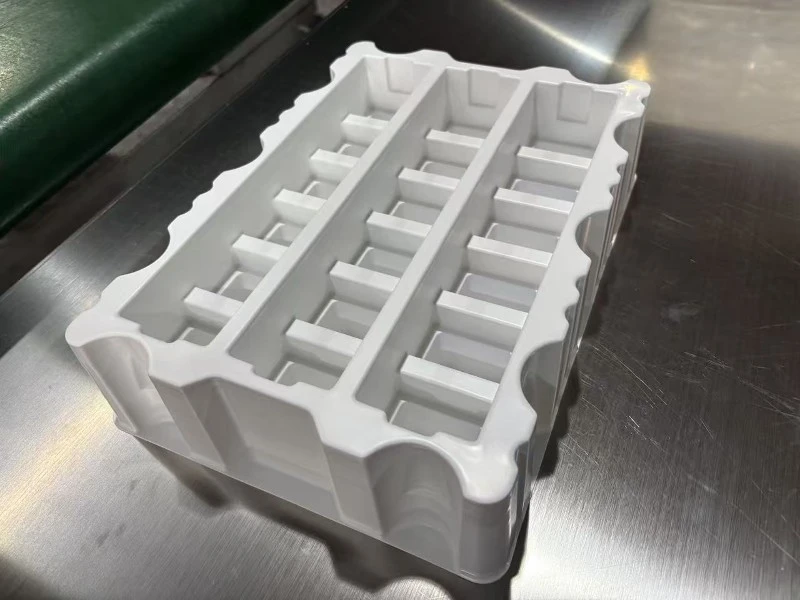
Permanent Antistatic Performance
For demanding industrial applications, we recommend materials with built-in, permanent antistatic properties.
Unlike removable coatings or migrating antistatic agents, permanent antistatic materials are designed to maintain their static-control characteristics throughout normal handling and use.
Depending on your application, we can evaluate materials such as:
Antistatic APET
Antistatic PET
Antistatic ABS
Other thermoformable antistatic polymers
Material selection is based on your required surface resistivity, mechanical strength, transparency or color, chemical resistance, forming requirements, and production volume.
Typical Surface Resistivity
1 × 10⁹ to 1 × 10¹¹ Ω/sq
The exact material specification can be selected according to your application and required static-control range.
Important: Antistatic performance should be verified on the actual material and finished thermoformed part, particularly when the tray will undergo repeated cleaning, heat forming, or other processing conditions.
Designed for Repeated Cleaning
Many industrial trays are not disposable packaging.
They are cleaned, returned to the production line, loaded again, and reused hundreds or thousands of times.
This creates a common problem:
A tray may meet the antistatic requirement when new, but what happens after repeated cleaning?
For applications involving alcohol-based cleaning, we can help select thermoforming materials with appropriate chemical resistance.
For example, if your process requires cleaning with 100% IPA (isopropyl alcohol), the material should be evaluated for:
Chemical resistance
Surface condition after cleaning
Dimensional stability
Mechanical strength
Retention of antistatic performance
For demanding applications, we recommend validating the finished tray rather than relying only on the raw material datasheet.
Custom Tray Design for Your Products
Every product has different handling requirements.
Our thermoformed trays can be engineered around your actual product dimensions and production process.
Key design parameters can include:
Pocket Dimensions
Each cavity can be designed to match the product geometry while allowing appropriate loading and unloading clearance.
Pocket Layout
Single-row, multi-row, symmetrical, or custom pocket arrangements are available.
Ribs & Reinforcements
Reinforcing ribs can be incorporated to improve rigidity without unnecessarily increasing material consumption.
Draft Angles
Appropriate draft angles help improve mold release and reduce forming difficulties.
Corner Radii
Optimized radii improve material distribution during thermoforming and help reduce thin areas around deep cavities.
Stacking Features
Interlocking or locating features can be incorporated when trays need to be stacked securely during storage and transportation.
Load-Bearing Design
For heavy products or multiple stacked trays, we can optimize the tray bottom, ribs, and support areas to improve load-bearing performance.
Lightweight Does Not Mean Weak
One of the major advantages of thermoforming is the ability to achieve a favorable balance between:
Weight + Material Usage + Rigidity + Tooling Cost
Instead of simply increasing the sheet thickness, our engineers can optimize the geometry of the tray.
Strategically positioned ribs, supporting walls, corner radii, and structural features can help increase rigidity while controlling material consumption.
This is particularly important when the tray must support multiple products or be stacked during transportation.
Thermoforming vs. Injection Molding
For low- and medium-volume custom trays, thermoforming can provide a more economical alternative to injection molding.
Thermoforming
Lower tooling investment
Faster tooling development
Suitable for large-format trays
Flexible design modifications
Efficient for low and medium production volumes
Easy to produce different tray configurations
Suitable for customized industrial packaging
Injection Molding
Higher tooling investment
Longer tooling development
Better suited to high-volume production
More complex tooling structure
Less economical for frequent design changes
For projects requiring hundreds to several thousand customized trays, thermoforming can often provide a more flexible manufacturing solution.
More Than a Tray Manufacturer
We are not simply supplying plastic sheets or forming existing designs.
As a custom thermoforming manufacturer in China, we can support the complete development process:
Product Drawing → DFM Review → Material Selection → Tooling → Thermoforming → CNC/Die Trimming → Assembly → Inspection → Packaging
Before tooling begins, our engineers can review your design and identify potential issues related to:
Material distribution
Deep drawing
Draft angles
Corner radii
Wall thickness
Rib geometry
Tooling complexity
Stacking
Part removal
Production efficiency
Our goal is simple:
Make the tray easier to manufacture before the mold is made.
Applications
Our custom antistatic thermoformed trays are suitable for a wide range of industrial applications, including:
Electronics Manufacturing
For handling and transportation of electronic devices, assemblies, housings, and components.
Electrical Components
For organized storage and production-line handling of electrical parts.
Automotive Electronics
For protective handling of automotive electronic components and assemblies.
Industrial Automation
For reusable trays used in production, assembly, and internal logistics.
Precision Plastic Components
For customized handling of plastic and metal components where static control is required.
Clean Production Environments
For applications where reducing dust attraction and controlling static charge is important.
Antistatic Tray or ESD Tray?
These two terms are often used interchangeably, but they are not always the same requirement.
An antistatic tray is designed to reduce the generation and accumulation of electrostatic charge.
An ESD protective tray is generally part of a broader electrostatic discharge protection system and may require additional electrical and packaging specifications.
If your products do not require full ESD protection but you want to control static charge during handling, an antistatic thermoformed tray may be the more appropriate and cost-effective solution.
If you are unsure which level of static protection your application requires, send us your product information and handling conditions. Our engineers can help evaluate the appropriate material and tray design.
Custom Antistatic Tray Manufacturing
We manufacture trays according to your specific requirements rather than offering only standard sizes.
You can provide:
2D drawings
3D CAD files
Product samples
Pocket dimensions
Tray dimensions
Material requirements
Surface resistivity requirements
Loading weight
Stacking requirements
Cleaning requirements
Annual quantity
Our engineering team can then recommend the appropriate material, thickness, tooling method, structural design, and production process.
Need a Permanent Antistatic Tray for Your Application?
If your current tray has problems with static buildup, cracking, deformation, difficult cleaning, insufficient rigidity, or high tooling costs, we can help redesign it for thermoforming production.
Send us your drawing or 3D model.
We can review the design, recommend suitable thermoforming materials, and provide a quotation for tooling and production.
Custom Tray. Permanent Antistatic Performance. Thermoformed for Your Application.
Please contact us : elenazheng@swellder.com whatsapp: 8613617041545